
Laying in her dorm at the University of Vermont, scrolling through TikTok one August afternoon, Rachel Stram randomly decided to slide open the TikTok camera to make her very first video about eating disorder recovery.
She was fed up with the pro-eating disorder and fatphobic content she was seeing on the app and felt inspired after seeing other pro-recovery videos from accounts with hundreds of thousands of followers — like @brittanilancaster and @victoriagarrick4. It just so happened that in one week her video reached over two million views, almost 800 thousand likes, and this virality started the journey of her eating disorder recovery account.
Stram used the green screen filter to insert herself over a chart of a “healthy” body full of fruits and vegetables and an “unhealthy” body full of fast food.
“We need to talk about these two images and why they’re used in elementary school classrooms and why it’s f*cked up and causes eating disorders and body dysmorphia,” she says.
Her TikTok video received more than 6,000 comments from users sharing their own traumatic experiences, and from others who criticised Stram saying that she was promoting obesity. She followed up with a series of less popular videos further explaining her point: skinny does not equal healthy.
Sitting on the bed in her white walled university dorm in a grey sweatshirt, black glasses and her hair pulled back into a high bun.

Now 21 years old, Rachel has struggled with eating disorders for over ten years. She says that she was always a chubbier kid, and she used to get bullied in elementary and middle school when she gained around 50 pounds between fourth and sixth grade.
When she was ten years old, both of her parents started to become more aware of healthy eating habits and introduced organic and whole foods to their household — her dad even opened his own functional holistic medical practice.
Seemingly overnight, all of the snacks that she once enjoyed — like ice cream and cookies — were replaced with carrot sticks and health foods.
“[A change like that] is very traumatizing, especially for someone so young that maybe doesn’t have other coping skills to deal with it could turn to food to manipulate,” Emma Demar, Licensed Master Social Worker, said. “Trauma is a huge factor and causation for eating disorders. It doesn’t have to be a huge event. It could be chronic trauma over the course of time,” Demar said.
Rachel struggled to cope with the sudden shock and change in diet as a 10 year old. Her brother no longer lived at home at that point, and her 17-year-old sister had more free will to choose what she ate when out of the house.
When Rachel visited friends houses, she would binge eat the foods that were no longer allowed in her home — pizza, pasta and other high carb foods. She’d even save up the 15 dollars of allowance she’d earn doing chores to buy sugary sweets and other foods she was told were “bad.” She stashed the sweets around her bedroom, away from her parents.
Up the street from her middle school near Albany, there was a pizzeria, called ‘I Love NY Pizza,” where Rachel walked to eat pizza with her friends, then buy milkshakes, cookies and muffins from Perfect Blend Cafe & Bakery next door before going home to have dinner with her family.
“A lot of times [eating disorders have] to do with wanting control over things that you feel like you don’t have any control over,” Emma Demar said. “It’s not about the food. It’s about trying to cope with something else that you’re dealing with — maybe depression, anxiety and other mental health disorders.”
The behavior of binging and restricting led Rachel down a dangerous path to extreme dieting and over exercising in high school. She ran for her school’s track team, where she would do intense workouts every day, and then would secretly go to the gym after practice to get in another workout.
“I didn’t think there was anything wrong with it,” Rachel said. “I actually thought it was good. But looking back on it, I wouldn’t go to plans, I would be late for dinner, I would just avoid it and lie and say I was doing something else.”
About six months into her weight loss journey, she was losing a lot of weight for a 16 year old due to overexercising and cutting out a lot of food, and was also pre-diabetic.
“Eating disorders are so competitive, they’ll literally take and latch on to anything to feed themselves and make themselves sicker,” Demar said.
For girls, the age of onset of eating disorders is getting younger and younger, Demar explains. Eating disorders are now more prevalent among preteen girls, a decrease from the former average of 16 years old. The rates of eating disorders in children under 12 has been growing in recent years, according to the National Institutes of Health, although no single cause has emerged.
With more than 800 million users on TikTok, over 60 percent of those users in the United States are between the ages of 16 and 24, according to a November 2019 release from Reuters.
Rachel joined TikTok for fun, but quickly realized her “For You Page” was showing her videos of young girls body checking — a compulsive behavior of zeroing in on parts of the body in a mirror. It often includes pinching your abdomen, frequently weighing yourself or scrutinizing the weight and shape of your body or face.
TikTok’s For You Page is an infinite scroll of videos recommended by a mysterious algorithm based on what the user interacts with. TikTok uses a recommendation system to curate each user’s FYP.
“These systems suggest content after taking into account user preferences as expressed through interactions with the app, like posting a comment or following an account,” reads a TikTok press release from June 2020.
Recommendations are based on a number of factors — including user interactions, video information and the device and account settings.
What makes TikTok different from sites like Instagram or Twitter is that its explore page will show videos from anyone on the platform, just not accounts the users follow. The problem with this is that a user can unwillingly come across videos that upset them or have a negative impact on their recovery, simply because they’ve watched and interacted with this type of content in the past.
Dr. Steven Skiena, a computer scientist, author and professor, rushed through a phone conversation on a Monday morning almost like he was caught at a bad time or one of his lectures was about to begin. He’s written eight books on data science, programming and computational mathematics. On his Wikipedia page he’s wearing a maroon sweater and a pair of frameless glasses, which he probably has to push up the bridge of his nose to keep from falling down. He wrote a book with a bright red cover about algorithm design, but TikTok wasn’t around when the book was published in 1997.
“When recommending videos, [TikTok doesn’t] have to look at the video at all,” he said. “They probably do have some level of image analysis, where they use computer vision techniques to figure out what is in the video.”
Algorithms can identify objects in a video — like animals, cars or toys — and analyze other aspects like language and music used.
“Let’s say you wanted to ban videos of people with eating disorders,” Skiena said. “[The algorithm] has to now recognize when a video is a problem. And that’s actually a hard thing to do. Computers are only as good as the examples they were shown.”
The video sharing app is only the latest in social media to see a rise of pro-eating disorder communities with a surge in eating disorder content, despite the fact that the community guidelines prohibits videos that “promote eating habits that are likely to cause health issues,” specifically content that encourages dangerous weight loss behaviors.

Video after video shows oftentimes young, emaciated girls revealing what they eat in a day, usually non-nutritional meals that are sometimes just bowls of ice chips with colorful spices on it. These same girls share tips on how to sleep to avoid hunger pains, diet hacks to lose the most amount of weight in the shortest time possible and recording themselves stepping on to scales.
The “thinspo” — short for thinspiration, or thin inspiration — community has a new home on TikTok after being banned on Tumblr, Pinterest and Instagram. The blogging website Tumblr has most notoriously been a place for #pro-ana and #pro-mia — short for anorexia nervosa and bulimia nervosa — communities to gather to post self harm messages, skin and bone photos and generally be mean to each other to encourage weight loss.
Tumblr birthed the idea of the infamous “thigh gap,” a thinspo goal of not having your thighs touch and being able to see through the gap between them. These blogs can be reported, but one photo of thin legs does not go against Tumblr guidelines.
These communities resided primarily on Tumblr until February 2012, when the updated terms of use banned any content that promoted or glorified self-harm including pro-eating disorder posts. The blogs didn’t completely disappear, but simply adapted. Some groups moved to Pinterest but were quickly evicted in March of the same year when all eating disorder content was removed from the site.
Before TikTok, Instagram was the latest site housing pro eating disorder communities. Now, those three sites do not allow for such content and give trigger warnings and helplines for those searching key eating disorder terms. Twitter does not provide help resources and still shows tweets that have pro-ana or pro-mia written or tagged.
A study found that in 2010 before the Tumblr self-harm ban, there were more blogs (593) promoting eating disorders than before the ban was implemented (559). When looking at the surviving blogs, researchers found that the remainders had only become more powerful in what they were posting and that it was harder for health professionals to reach those who were struggling.
“[The highly problematic nature of these photos] can be very triggering and very encouraging for someone that is struggling,” Demar said. “They might be looking for tips and tricks to feed their eating disorder, and seeing other people trying to do the same thing builds communities on these platforms. It’s extremely toxic. I’m not sure why it’s even allowed.”
Many of these bloggers describe their eating disorders as “lifestyle choices” rather than diseases.
“Eating disorders are an addiction, people with eating disorders usually have an addictive personality,” Demar said. “They might be binging on these photos and videos — binging is not just for food.”
In a study published in the Journal of Youth and Adolescence conducted in January 2020, researchers tested the relationship between social media and body image. They discerned that selfie-taking is a new form of body checking — more selfie taking lead to more body checking which in turn leads to greater severity of eating disorders.
The researchers investigated the potential relationship between online and offline selfie taking behavior and eating disorder symptom severity. Self-esteem and depressive symptoms were directly linked with the social media body ideal.
Both the frequency of selfie-posting and the frequency of offline selfie taking were unrelated to ED symptoms via body dissatisfaction. However, the more offline selfies individuals took, the more body checking behaviors they reported, which, in turn, was associated with more severe ED symptoms.
“[TikTok] allows for people’s messages to be conveyed in a far more potent way,” Rachel Rodgers, the primary researcher, said. “When people post what they eat in a day, you get a sense of time passing which gives the illusion of it being more credible or real.”
Rodgers is currently doing more research about body image and eating disorders and how they relate to TikTok.
***
Junior year of high school was Rachel’s worst year. She reached her lowest weight and was going through a break up, was obsessed with the number on the scale and was hyper aware of her body. She was exercising multiple times a day and typically eating one meal a day. A couple times a month she would binge eat her hidden “bad” foods.
Her body couldn’t sustain itself at this weight. Standing at five feet seven inches tall, the Body Mass Index scale says this weight is “normal.”
The BMI has long been criticized, and the University of California, Santa Barbara says that the scale is flawed and does not account for variation in body shapes or differentiate between fat and muscle mass.
It wouldn’t be until sophomore year of college — four years later — that Rachel started to feel better and change her eating and exercise patterns.
She studies human development and nutrition at University of Vermont. One fall day, she was sitting in a nutrition lecture when she realized that what she was doing to herself and to her body wasn’t healthy and started to take health and nutrition more seriously.
“It took a lecture setting to feel targeted and called out in my behaviors,” Stram said. That lecture was what made her pivot to a healthier lifestyle and realize that the scale is not important.
Learning about healthy and unhealthy relationships with food in class made her realize: “maybe what I’m doing to myself is bad.”
When she was 19 and a freshman in college, she was diagnosed with hypothyroidism — a condition that includes rapid, unexpected weight gain. Before her diagnosis, she was blaming herself for gaining weight, and bingeing a few times a week to feel better and comfort herself.
After her diagnosis and nutrition classes, she cut out a lot of processed foods from her diet and began to workout again.
It is possible to develop a healthy relationship with food in recovery.
“One thing I’ve found that’s been really helpful for my patients specifically, is intuitive eating and learning and relearning their hunger/fullness cues because with an eating disorder, you shut that off,” Demar said.
In 2010, a team of researchers from the United Kingdom, United States, Australia and Europe submitted scientific research and evidence of the impact of media images on body image and behaviors to the Advertising Standards Agency (ASA) and the Committee of Advertising Practice.
“Advertising, the mass media (including the World Wide Web), and consumer culture highly profile ‘body perfect’ ideals that are both artificial and biologically inappropriate,” the study reads. “Media images that depict ultra-thin, digitally altered women models are linked to body dissatisfaction and unhealthy eating in girls and women.”
The study concluded a number of findings including — body image is highly significant for mental and physical health, exposure to media images has detrimental long term effects that start occurring in early childhood and that alternative advertising images of plus sized models avoid harm and are equally as effective.
Fast forward ten years and now you’ll see the rise in popularity of the body positivity movement. More and more people are posting online about accepting themselves and the way their natural bodies look.
The basic premise of Health at Every Size, taken from Linda Bacon’s book Health at Every Size: The surprising truth about your weight is that it acknowledges well-being and healthy habits are more important than any number on a scale.
Every therapist and eating disorder specialist interviewed for this story iterated the importance of Health at Every Size along with the body positivity movement. HAES stresses the importance of intuitive eating — eating when you’re hungry and stopping when you’re full — and accepting and loving your body the way it is.
“The truth is, if we all ate the exact same diet and did the exact same exercise routine, we’d all still look different and have different body types,” Dr. Waitt said.
Tina Vaughn was only 12 years old when she joined social media. She would scroll through pro eating disorder tags on Tumblr for hours thinking that it was normal — she thought everyone was looking at “thin is beautiful” accounts.
She viewed her eating disorder as a dark, shameful secret that she couldn’t share with anyone and turned to the Internet to interact with other people with eating disorders. These communities allowed her to indulge in unhealthy thoughts she was having about herself, not recognizing that it was harming her even more.
Now, on TikTok, she’s being reminded of the days when she first joined social media and was bombarded with photos of people with a perfect, unobtainable body type for her.
“[Being on social media at a young age] really instilled this deep hatred of self that I still struggle with today,” Tina said. “Tumblr and Pinterest and even Instagram having perfect photos of beautiful girls would always make me think — ‘I don’t look like that.’”
An Australia-based study conducted by Simon Wilksch, PhD et al. found that having social media accounts was associated with increased disordered eating behaviors in young adolescents than those without social media accounts. They also concluded that the relationship between social media and disordered eating occur at ages younger than previously researched.
TikTok’s owner, Chinese company ByteDance, has reported to have taken some steps to stop the harmful content. Users who search for #pro-ana and #pro-mia are directed to a support page with the National Suicide Prevention Lifeline. Still, common misspellings of these terms — like anarexcia and bulim1a — evade these filters and have millions of views.
Eating disorders are the most fatal type of mental illness and have a higher rate of mortality than any other psychiatric disorder, according to the National Association of Anorexia-Nervosa and Associated Disorders (ANAD.)
“Specifically anorexia because there’s so many side effects and health problems that come with starvation,” Demar said. “Our bodies are not meant to be starved.”
The health effects of anorexia nervosa include liver, kidney and heart problems, osteoporosis, muscular atrophy, menstrual irregularities, dental problems and lanugo — a fine coat of hair covering the body.
A Tumblr pro-recovery blog called “eatingdisoderconfession” has over 40 thousand followers and serves as a safe place for users to be honest about their struggles and recovery triumphs. Its owner, Erin Huston, started the blog in 2014 during her undergraduate years after a separate blog she moderated — “eatingdisorderconfessions” — was shut down by Tumblr.
The two blogs follow the same premise — allowing anonymous submissions to talk about eating disorder experiences. The blog was terminated for promoting eating disorders. Erin said that there were no rules or guidelines that she and other moderators followed. They allowed almost any submission to be posted.
Erin and Tegan — another founder of eatingdisorderconfessions — restarted eatingdisorderconfession from scratch. They wanted people to be able to safely talk about their eating disorders online without the behaviors being glorified.
For every confession posted, there is a recovery post or article with helpful tools posted. Erin and Tegan still run the blog, but are not as active as they once were. They instilled strict regulations for new moderators to follow. They cross out all food names, nutrient numbers and ED nicknames in all submissions in an effort to control the problematic glorification.
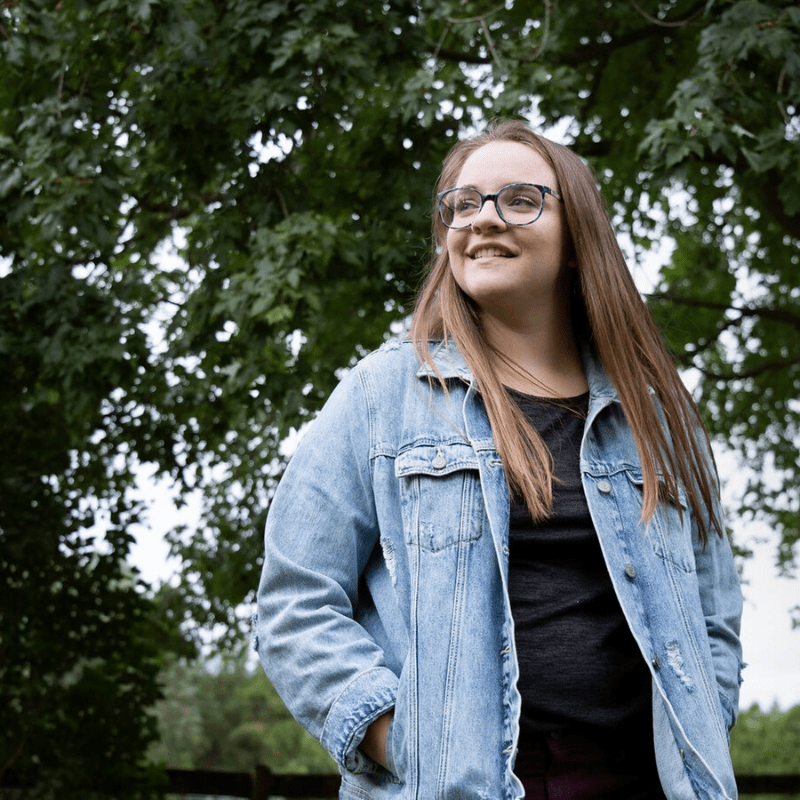
Erin is a trailblazer in advocating and creating safe space for bodies that have been traditionally marginalized. She’s won several awards — including the Body Confidence Canada Award in 2015 — and been nominated for others like the Middlesex County Champion of Mental Health Award in 2017.
She uses her own lived experience with eating disorders and depression to lead workshops and focus on her research on the body positivity movement.
The Canada native now works for Body Brave — a charity that provides accessible and affordable eating disorder treatment and support in Ontario. She started there in student placement during her masters program at Wilfrid Laurier University. The grassroots organization has created several novel treatment approaches like becoming the first community treatment program to offer accessible, cost-free virtual eating disorder treatment in Canada.
In 2019, Body Brave launched its first ever Body Peace Conference — a two day virtual eating disorder conference. Erin is the coordinator of the conference and is organizing the second year of the conference happening November 19 and 20. Last year there were over 200 participants from four continents.
She said that they always planned for the conference to be online to make it as accessible as possible because oftentimes conferences can be fairly expensive to attend — with travel, food and accommodation added on top of registration. She and the Body Peace team didn’t want that to be a barrier to people trying to access different tools for recovery who couldn’t pick up and leave for two days.
Being completely online has boded well for them in this climate where everything is online. They already have a year under their belt for their second time around.
The conference hosts speakers to talk to three three different types of participants — individuals with lived experience, caregivers and healthcare professionals.
The National Eating Disorders Association says an estimated 20 million women and 10 million men in the United States will have an eating disorder at some point in their lives.
***
Halfway across the country sitting in her Sherman, Texas home in March, Dr. Stephanie Waitt is watching her god daughter punch the air, swing her hips and do the wave with her arms performing the renegade — a popular TikTok dance — in her living room. These dances were one of Waitt’s first introductions to the social media app, besides the countless videos sent from her husband and friends in a group chat. She often ignored the messages that contained links to TikTok videos because she thought they were annoying and had no interest in watching them.
They urged her to join the app just to watch the funny videos they would send. After finally caving in — and posting a video of herself lip syncing along to “Lose Yourself” by Eminem — she was almost immediately unsettled by the types of videos she was being shown on her For You Page. It reminded her of a time when she struggled with body image and orthorexia — an eating disorder that involves an unhealthy obsession with healthy eating.
The content she was consuming was all rooted in diet culture. At that point she hadn’t seen any other specialists or professionals using the space for education and realized that she could do exactly that, and started to quickly edit together some pro-recovery videos in hopes of drowning out some of the harmful pro-ana content that she couldn’t believe was on her feed.
She remembered seeing pro-ana posts back in the 90s when she was growing up, long before TikTok, Tumblr or Twitter.
“It’s crazy that pro-ana is still a thing. It’s more subtle now, almost taking language from Health at Every Size and the body positivity movement,” she said.
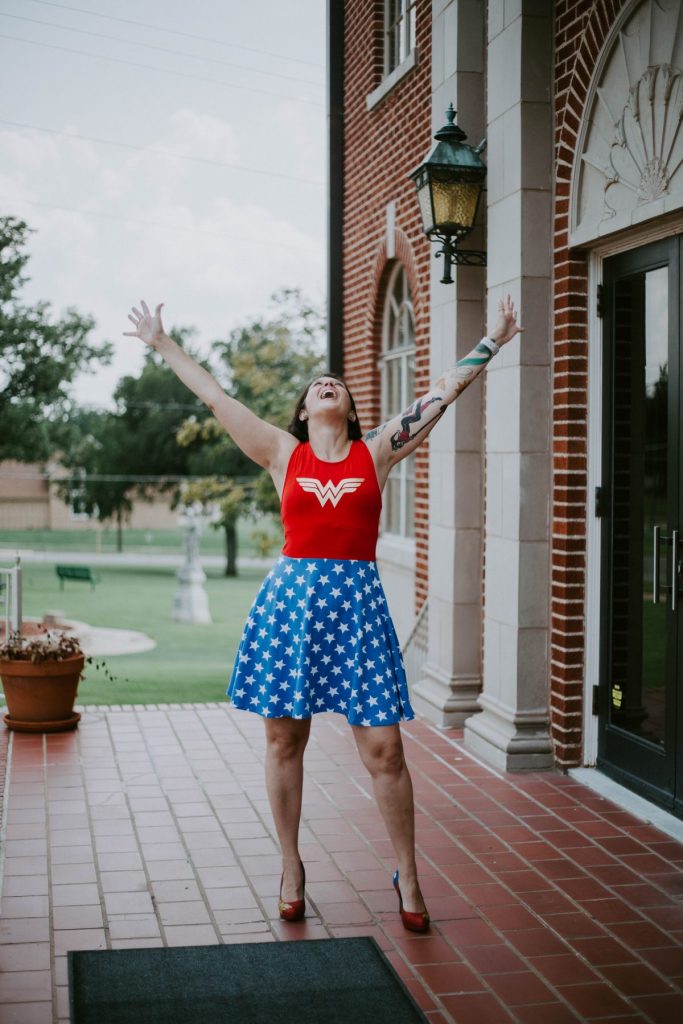
Dr. Waitt is a Licensed Professional Counselor with a PhD in health psychology. She specializes in treating patients who struggle with eating disorders, sexual trauma and anxiety. She grew up in the Texoma area, a portmanteau of the region between Texas and Oklahoma.
Many of her videos have hundreds of comments of viewers telling her how much her account has helped their recovery process. Others use the space to tell Waitt what they ate for breakfast or lunch that day. She responds to one comment with a video of her dancing to Paper Planes by M.I.A in a dimly lit room. Her normally long, black curly hair is out of her signature ponytail, straightened and hanging to the middle of her back. The faded streaks of red and brown hair dye are prominent, not being hidden by her curls. Her full sleeve tattoos show underneath the olive green tank top she’s wearing. Her arms are covered with quotes, mermaids and Wonder Woman — to name a few. She writes in red text on the screen: “I’m living for all the ED support y’all give here,” her southern twang showing even through the text.
Between her flailing arms and high kicks, each dance move is punctuated with helpful recovery tips or words of encouragement. If she’s not partaking in the latest dance trend, she will post Point of View videos to make the viewer feel included and accepted — sometimes just by simply sitting there eating a meal with the caption: “Just two people vibing and eating because they are hungry, it’s okay to eat and we know we don’t have to earn our food!”
She would have never joined the app if COVID hadn’t hit Sherman, Texas. Now, six months after the outset of the pandemic, Waitt has garnered over 35 thousand followers by posting a unique mix of educational eating disorder facts — like how EDs are not always about losing weight and can be associated with other traumas in life —combined with the latest trendy dance moves.
“Viewing “what I eat in a day” videos can cause people with EDs to doubt themselves and question what they eat. They wonder ‘is this normal? Should I be eating this or eating less?’” Waitt said.
The biggest problem with online eating disorder communities is being able to safely talk about their struggles and experiences without the behaviors being glorified.
Waitt says she gets frustrated seeing videos detailing specific behaviors. She and Emma Demar both agree that if you’re talking about an eating disorder on social media and sharing your story, don’t use the specifics. Don’t go into details. Her key advice is to be as general as possible or to put a trigger warning at the beginning of videos.
A popular TikTok song “Prom Queen” by Beach Bunny features lyrics about insecurities and eating disorders — “shut up, count your calories,” “I’ve been starving myself, carving skin until my bones are showing.” Almost 50 thousand videos feature the sound. One of the most followed TikTok users, Addison Rae caused controversy in June when she posted a now-deleted video of her swaying her hips and dancing provocatively to the song.
Thousands of people reacted to the video with their own ED experiences such as “Addison is dancing to the song I used to listen to while I forced myself to throw up” and “I used to cry at 2am to this song.”
Quickly, others posted videos demanding that people stop broadcasting the harmful ways they used to hurt themselves.
One user, @hannahmcwilly posted “Eating disorders are the most competitive mental illness. Your video about how you extremely starved yourself is a lot more triggering and damaging then addison rae dancing to this song.”
In September, Charli D’amelio — the most followed person on TikTok with over 90 million followers — opened up about struggling with eating disorders. The 16-year-old posted a lengthy Instagram story revealed her “own struggles with eating disorders” in hopes that she inspires others to seek help.
“I know [eating] disorders are something that so many other people are also battling behind closed doors,” she said.
She went on to apologize for using and dancing to any songs with triggering lyrics, not realizing how it may have upset people. Charli has also danced to “Prom Queen” and has also deleted the videos.
Recovery videos can be a double edged sword as some people can still be triggered by them. Insecurity and body image know no size and can be experienced by anyone, but many body positive influencers are still thin white women.
An Instagram influencer Sarah Nicole Landry, @thebirdspapaya, frequently posts photos of her body with essay captions on learning to accept herself. She is a mother of three and often points out her stretch marks and loose skin and her struggles with her own body image. What makes her different from typical influencers is that she acknowledges that she has “thin privilege.” While she struggles with her body image, she knows that she has a body type that many people strive for.
In August the United Kingdom National Obesity Forum suggested weighing students returning to school to track and encourage weight loss associated with COVID-19 quarantine. This sparked outrage on Twitter, with many citing eating disorders and self esteem issues for children.
Thinking about potential weight gain during COVID is already a huge stressor for many people. Researchers in Italy found that quarantine significantly impacted people with EDs, both in terms of post-traumatic symptomatology and interference with the recovery process. Being stuck at home with easy access to the food in their kitchens made patients with anorexia-nervosa and bulimia-nervosa experience more severe symptoms.
“These behaviors often represented a way to manage adverse emotions related with the forced isolation of lockdown,” Giovanni Castellini, the primary researcher, said. “[Weighing students] could increase pathological habits such as compulsive weight checking or body uneasiness.”
Body Brave saw a huge influx of people accessing resources for disordered eating and self esteem issues around the beginning of April, when COVID first became a major problem in North America.
Erin said she saw a lot of social media posts on how to avoid the “quarantine 15.” For schools to be pushing for weight loss as if it is the sole indicator of health encourages a weight bias and is more detrimental to health than weight itself.
Rachel doesn’t consider herself to be in full recovery.
“Every day is a struggle and this type of recovery is non-linear,” she said.
She is focused now on eating healthier and exercising to make her body look and feel stronger. She focuses on strength training and less on cardio, although she does enjoy going for runs — running is a personal joyful movement for her.
After a year of focusing on herself and being healthy, Rachel is at her healthiest both with her relationship with food and her own personal journey. She’s learned that the number on the scale is not important and does not indicate physical or mental health status and is focused on being the strong and healthiest version of herself she can be.
 Deanna Albohn